
For some time now, I’ve carried this quote in my mind. It surfaced when I needed it, and it has stayed with me since.
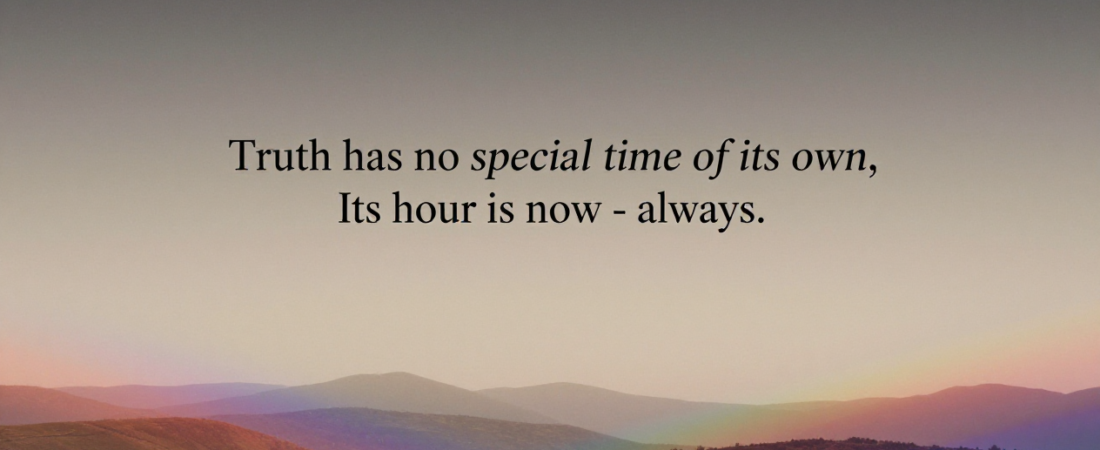
“Truth has no special time of its own, Its hour is now – always.”
The words are attributed to Albert Schweitzer, the philosopher and physician, but their power lies beyond attribution. They point to something fundamental about how we relate to reality – and how we often avoid it.
What This Quote Means And Its Implications.
Truth Is Timeless and Constant
The first part – “Truth has no special time of its own” – strips away a common illusion. We often treat truth as something we can schedule, something that will wait patiently until conditions improve. But reality doesn’t work that way.
The facts of a situation don’t change because the timing is inconvenient. The state of our health doesn’t pause while we finish a stressful project. The condition of a relationship doesn’t improve while we avoid the difficult conversation. Truth exists independently of our comfort, our schedules, and our readiness. It has no “special time” because it doesn’t answer to us at all.
The Imperative of the Present
The second part – “Its hour is now – always” – is a call to action. It rejects the common human tendencies to procrastinate (“I’ll deal with that later”), deny (“That can’t be true right now”), or wait for better circumstances (“The timing isn’t right”).
There is no “better time” coming. The present moment is the only moment we ever have to engage with what’s true. Waiting for conditions to align is often just fear dressed up as prudence.
A Moral and Ethical Demand
The quote carries an ethical weight. It implies that we have a responsibility to face and speak the truth now, regardless of consequences. To delay is often a form of dishonesty – not just with others, but with ourselves. Integrity requires aligning ourselves with truth in the present, not deferring it to some imaginary future.
The Loop I Couldn’t Close
Understanding this conceptually was one thing. Living it was another.
I’ve noticed a pattern in my life, and maybe you’ll recognize it too. Something needs attention – a conversation, a decision, a change I know I need to make. I feel the pull of it. But instead of acting, I tell myself a story: *Not yet. I need more information. I need to be in a better headspace. I need to wait until things settle down.*
And so I wait.
Here’s what I’ve learned: the conditions usually do not improve. The fear doesn’t shrink. The situation doesn’t resolve itself. The “better time” usually remains perpetually around the corner – always visible, never arriving.
A Moment of Recognition
(fictional story to illustrate an example)
Imagine sitting in your car outside a health coach’s office, engine running, telling yourself you’ll reschedule. Work is too busy. You’ll go next month, when things calm down. You drive away.
Two years pass before you finally walk through those doors.
What could have been addressed simply has, by then, become complicated. The truth of the body’s condition didn’t wait for convenience. It continued its course. The only thing that changed was the cost of addressing it.
This pattern – confusing waiting with wisdom – is one many of us know well. We tell ourselves we’re being patient, being strategic, waiting for the right moment. But often, we’re simply afraid, and “the right time” is the story we tell to make that fear feel reasonable.
The Cost of Postponement

One of the most exhausting things we do is maintain the gap between what we know and what we’re willing to face.
It takes energy to avoid the conversation. It takes energy to ignore the signal. It takes energy to construct the narrative that lets us off the hook – just for now, just until things are better, just until the timing is right.
When I finally stop deferring and face what’s true, something shifts. The situation may still be difficult, but I’m no longer fighting on two fronts: against reality, and against my own awareness of it. The exhaustion lifts – not because the problem has disappeared, but because I’ve stopped pretending I could outwait it.
A Question I Now Ask Myself
Here’s a question that can change how I move through life:
What am I waiting for the “right time” to address?
I try to ask it when I notice the familiar feeling of deferral – the subtle tension that comes from knowing something needs attention and choosing to delay. I try to ask it when I catch myself rehearsing reasons why now isn’t quite right.
When I answer honestly, I usually find that the “right time” is a story. The truth underneath is simpler: I’m afraid, or I’m uncertain, or I don’t want to face the discomfort.
But here’s what else I’ve found: the discomfort of facing truth is almost always shorter and more manageable than the chronic weight of avoiding it.
The Practice
I don’t write this from a place of mastery. I still defer. I still catch myself waiting for conditions that might never arrive. In fact, as I am writing this I am realizing I have been postponing at least 1 difficult conversation that I should take. I’m also learning, alongside this, about Nonviolent Communication – finding ways to speak truth that are both honest and compassionate. The combination is powerful: truth without skill can wound; skill without truth can obscure. Both are needed.
This quote has become a touchstone for me. When it surfaces in my mind, I try to pause and look around: What am I avoiding? What truth is sitting right here, waiting for me to acknowledge it?
If you’re reading this and something has come to mind – a conversation you’ve been postponing, a decision you’ve been deferring, a truth you’ve been holding at arm’s length – then perhaps this moment is worth paying attention to.
Not because it’s the perfect time. But because now it’s the only time that actually exists.
Truth’s hour is now – always.
The question isn’t whether the time is right. The question is whether we will meet what’s true, here, now, in the only moment we will ever have.
